
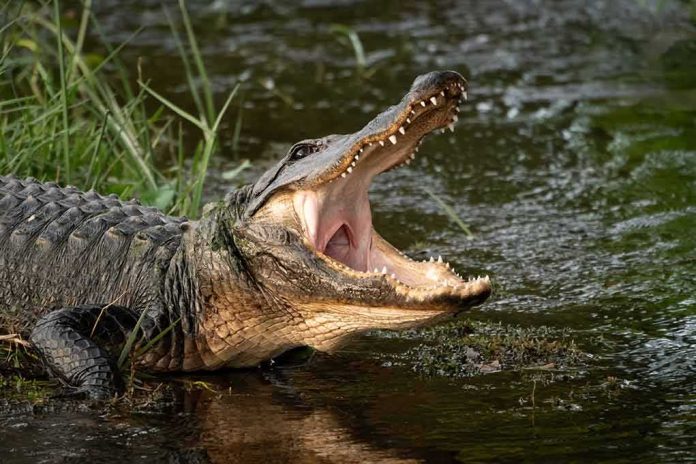
A 71-year-old Florida man fishing near his own neighborhood lake was pulled into the water and killed by a nearly 12-foot alligator, while rescuers had to fight through more gators just to recover his body.
Quick Take
- Steven Hamilton, 71, of Winter Garden, was fishing at Dr. Bradford Memorial Park when an alligator attacked him.
- Crews responded around 5 p.m. after a 911 call, but other alligators in the water slowed the rescue.
- His body was recovered roughly two hours later near Lake Apopka.
- State wildlife officers removed an 11-foot-8-inch alligator from the area as a public-safety measure.
- Florida records show alligator attacks are rare but deadly when they happen, with 32 fatalities since 1948.
A Routine Fishing Trip Turns Deadly
Steven Hamilton was doing something millions of Floridians do every week: fishing near the water close to home. The Florida Fish and Wildlife Conservation Commission said Hamilton, a Winter Garden resident, was bitten by an alligator while fishing at Dr. Bradford Memorial Park. Responding personnel pronounced him dead at the scene after Winter Garden police and fire crews arrived around 5 p.m. following a 911 call.
Officials say Hamilton was fishing from the shoreline, not swimming, when the attack happened. Winter Garden officials told local reporters he was on the shoreline of a retention pond connected to Lake Apopka, and The New York Times reported he was bitten on the leg while standing on shore. That detail matters. This was not a reckless swim in gator-infested waters. It was a man fishing from dry land, doing everything right, when nature struck without warning.
Rescuers Faced Their Own Danger Pulling Him Out
Recovering Hamilton’s body was not simple or quick. Winter Garden Fire Chief Jose Gainza said other active alligators in the water complicated the rescue effort, forcing crews to proceed carefully before his body was finally recovered roughly two hours later. That detail alone shows the real risk first responders took on to bring a neighbor home to his family, working in water shared with more than one apex predator.
Florida Fish and Wildlife Conservation Commission and Winter Garden police are now jointly investigating the attack, a standard procedure when a fatal wildlife incident occurs on public land. A contracted nuisance-alligator trapper removed an alligator measuring 11 feet 8 inches from the area, which Winter Garden police described as nearly 12 feet long and a danger to the public.
Florida’s Alligator Removal System Did Its Job
Florida runs a Statewide Nuisance Alligator Program built specifically for moments like this, giving the Florida Fish and Wildlife Conservation Commission authority to send trappers after alligators that threaten public safety. In this case, the system moved fast: a large alligator was identified, captured, and pulled from the area within the same response. That is limited, targeted government doing exactly what it is supposed to do, protecting citizens without turning into a bureaucratic nightmare.
State data put this tragedy in perspective without diminishing it. Florida has logged nearly 500 alligator bites since 1948, with 32 resulting in death, meaning fatal attacks remain uncommon even in a state with more than a million alligators. Florida recorded 13 total bites in 2025, 11 in 2024, 23 in 2023, and 11 in 2022, numbers that have stayed in the low teens most years. Researchers have also found that in the vast majority of cases, human inattention near the water, not gator aggression, drives these encounters.
A Community Grieves a Familiar Face
Hamilton was a Winter Garden resident fishing in a park his neighbors likely visit often, the kind of everyday local spot where families expect to enjoy Florida’s outdoors safely. His death is a sober reminder that living alongside wildlife, even in a well-run state with an active removal program, carries real and sometimes fatal risk. The investigation by local police and state wildlife officers continues, and Floridians near lakes and ponds are being urged to stay alert near the water’s edge.
A fishing trip turned fatal for a Florida man, 71, who was killed by a nearly 12-foot alligator along the shore of Lake Apopka in Winter Garden.
Emergency crews attempted to rescue the victim, but couldn't reach him because other alligators were also in the water, according to… pic.twitter.com/AMSAjhxqaR
— Fox News US (@FoxUSNews) October 18, 2026
What happened to Steven Hamilton underscores a truth conservatives have long pushed for in wildlife and land management: effective, accountable state agencies matter more than endless red tape. Florida’s wildlife commission responded, investigated, and acted. For a grieving family, that response can’t undo the loss, but it shows government working the way it should, protecting the public swiftly and without excuse.
Sources:
foxnews.com, wftv.com, nbcnews.com, people.com, wtsp.com, news-journalonline.com, myfwc.com