When an arson case is built around time-stamped video and a tight investigative timeline, the story tends to sound simple; in Charleston, West Virginia, police and prosecutors moved on precisely that combination after surveillance footage allegedly captured a young couple setting a vacant house ablaze and leaving as the fire took hold.
At a Glance
- Investigators cite surveillance video placing Dakota Harper, 21, and Felicity Eatmon, 22, beside a vacant home immediately before it ignited.
- A criminal complaint describes Eatmon handing Harper what appeared to be paper, which he lit with a handheld source and placed inside the structure.
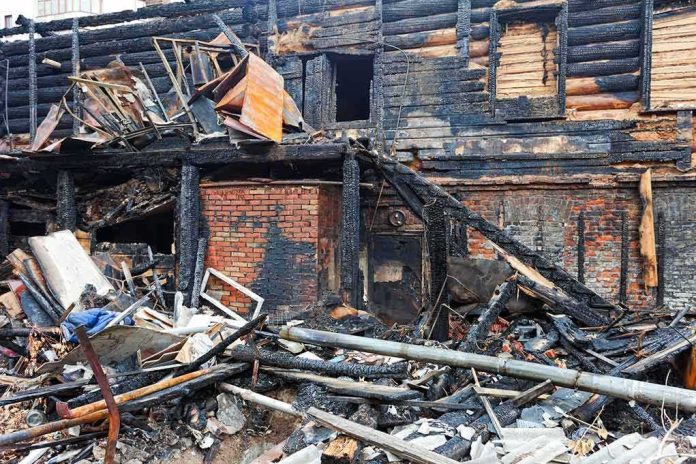
- The blaze originated at 405 Maryland Avenue on Charleston’s West Side around 11:15 p.m., damaging a neighboring church.
- Both were arrested and charged with first-degree arson and conspiracy to commit arson in Kanawha County Magistrate Court.
What Investigators Allege Happened on Maryland Avenue
According to court-record-based reporting, Charleston investigators obtained surveillance video that placed Harper and Eatmon in an alley adjacent to 405 Maryland Avenue immediately before the fire. In the complaint summarized by several outlets, Eatmon appears to hand Harper a piece of paper, which he then lights using a handheld ignition source and places into the vacant residence. The footage timeline reportedly continues with the pair returning to a side door as the fire begins to develop; accounts say they partially entered the structure before departing as the flames intensified. The house was described as vacant and without utilities, a detail that typically narrows accidental-cause hypotheses and reinforces an incendiary theory when coupled with direct ignition on video.
The specific location, time window, and conduct are consistent across multiple independent reports. The fire occurred around 11:15 p.m. on a Sunday, on Charleston’s West Side, and the case file advanced quickly to arrests and arraignments. Both defendants face first-degree arson and conspiracy counts, the principal felony charges used when the state alleges intentional ignition of a dwelling—even if unoccupied under West Virginia law—and coordinated participation by more than one person. A nearby church incurred thousands of dollars in damage from the incident as reported by several accounts, a collateral impact that can affect both charging posture and potential sentencing exposure if the state proves its case.
How the Evidence Package Fits Modern Arson Cases
Fire investigations today are grounded in two complementary pillars: cause-and-origin work at the scene and corroborating documentation—often surveillance video—that ties human action to the point of ignition. NFPA 921, the field’s guiding methodology, calls for systematic data collection, scene mapping, and hypothesis testing to rule out accidental causes before an investigator classifies a fire as incendiary. Video evidence, when it exists, does not replace that process; it anchors the timeline and human presence while the technical work addresses whether the burn patterns, heat and smoke movement, and material residues align with an intentional set.
In the Charleston case as reported, the state’s narrative emphasizes the video chronology: identifiable individuals, a moment of handoff, an ignition source, placement of burning material, and a brief reentry as the fire grows. That sequence is the kind of visual story juries intuitively understand; it shows opportunity and action rather than mere presence near a scene. In parallel, standard practice would involve documenting the structure’s interior and potential ignition points, photographing burn patterns, collecting samples for lab analysis when appropriate, and confirming that utilities were indeed disconnected—each a step that strengthens an incendiary conclusion under accepted investigative standards if the findings are consistent.
Charges, Statutes, and Why “Vacant” Still Matters
First-degree arson in West Virginia tracks the protection of dwellings as places of habitation and community risk; the statute’s reach is not limited to occupied homes. Vacant houses in dense neighborhoods can propagate heat and flame to adjacent structures, particularly older churches and multifamily units built with legacy materials that transmit fire and smoke quickly through rooflines or shared voids. That public-safety rationale is why prosecutors commonly bring top-count charges when a dwelling is at issue and the facts suggest an intentional set, regardless of utility status or interior contents.
Conspiracy accompanies many incendiary prosecutions where investigators allege coordinated roles—supplying combustible material, lighting, acting as lookout, or re-entering to manipulate a set. On a surveillance timeline, prosecutors often argue these roles manifest as discrete, observable behaviors: a handoff, a light, entry, and exit in close temporal proximity to the first visible flames. When combined with a vacant structure and late-night timing, the state’s theory typically frames the behavior as purposive rather than accidental or negligent.
Media, Virality, and the “Caught on Camera” Effect
Stories that pair social-media notoriety with alleged wrongdoing tend to accelerate through the attention economy. The Charleston arrests drew coverage precisely because of the defendants’ online presence, which in turn amplified the “caught on camera” framing across national and local outlets repeating the same core allegation drawn from a criminal complaint and surveillance narrative. That dynamic is common: visual evidence compresses complex investigative work into a sequence viewers think they understand, even as the full case file—scene documentation, lab testing, and chain-of-custody records—moves through standard channels to court.
For readers sorting substance from spectacle, the reliable markers are straightforward. Look for convergence across independent outlets on the who, where, and when; look for specifics in the alleged sequence of actions tied to a precise location; and look for charge language that matches the described conduct. Here, those anchors are present: named defendants, a fixed address and time, a described ignition handoff and placement, and felony counts filed in magistrate court grounded in West Virginia arson law. A single sentence caveat remains appropriate in any pending case: charges are allegations, and the defendants are presumed innocent unless and until the state proves them beyond a reasonable doubt.
A TikTok couple from West Virginia is facing serious felony charges after investigators say surveillance footage captured the pair allegedly setting fire to an abandoned home in Charleston.
Dakota Harper, 21, and Felicity Eatmon, 22, were arrested Tuesday and charged with… pic.twitter.com/mAVIf6PC1E
— The Gateway Pundit (@gatewaypundit) October 2, 2026
What Comes Next Procedurally
From here, the process moves on two tracks. Prosecutors will aim to align the surveillance sequence with standard fire-investigation findings—utility status, burn patterns, and any physical residues consistent with paper or other combustibles. Defense counsel, for their part, typically probes identification, timeline continuity, and alternative-cause hypotheses if the scene work allows. In arson litigation, that interplay is routine: video provides a narrative spine, while NFPA 921–style analysis supplies the scientific vertebrae. A case holds when those components reinforce each other and the chain of evidence is unimpeached; it weakens when they do not.
Sources:
thegatewaypundit.com, nebraska.tv, tmz.com, wchsnetwork.com, ladbible.com, cbsaustin.com, usmagazine.com, amu.apus.edu, supremecourt.ohio.gov