
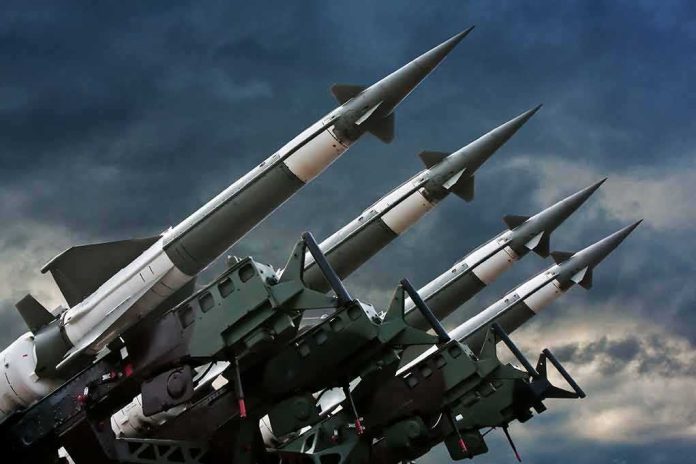
Arms control fails the moment one party treats a ban as an asymmetry to exploit; what follows is not a return to equilibrium but a redesign of the battlefield. The demise of the INF Treaty over Russia’s 9M729 opened precisely that kind of redesign, culminating in the U.S. Army fielding Typhon—mobile, land-based launchers for Tomahawk and SM‑6—that reoccupy the ground-launched mid-range envelope the treaty erased for three decades.
The Short Version
- The United States determined in 2014 that Russia violated the INF Treaty by developing and fielding the 9M729; Washington withdrew from the treaty in 2019 after allied consultations and formal notice.
- Russia denied wrongdoing, claiming the 9M729 stayed within the treaty’s 500 km ceiling; NATO and U.S. intelligence rejected those claims as non-credible.
- Freed of INF constraints, the U.S. Army built Typhon, a ground-mobile launcher for Tomahawk and SM‑6 that fills a 500–1,600 km strike gap in the land force.
- The return of ground-launched mid-range weapons is reshaping deterrence, logistics, and alliance politics in Europe and the Indo-Pacific.
What the INF Treaty Banned—and Why It Broke
Signed in 1987, the Intermediate-Range Nuclear Forces (INF) Treaty eliminated all U.S. and Soviet (later Russian) ground-launched ballistic and cruise missiles with ranges between 500 and 5,500 kilometers. It was a category ban—no possession, no testing, no deployment—enforced by an intrusive verification regime born of the Pershing II–SS‑20 standoff. Beginning in 2014, the U.S. government concluded Russia had breached that bright line by developing and fielding the 9M729 (NATO: SSC‑8), a ground-launched cruise missile whose range fell squarely inside the prohibited band. Washington repeatedly pressed Moscow for a credible explanation and a path back to compliance; none materialized. In February 2019, the United States suspended its obligations and provided six months’ notice of withdrawal under Article XV, completing that withdrawal in August 2019, explicitly citing Russia’s continuing noncompliance.
Moscow’s defense was consistent but thin on verifiable specifics: the 9M729, officials said, never exceeded 500 kilometers and had not been tested to a banned range; they characterized it as an upgrade to an existing missile rather than a new treaty‑restricted system. U.S. and allied assessments did not find those assertions persuasive, and NATO publicly aligned with the U.S. position that Russia had developed and fielded a violating system and offered no credible route to fix it. In other words, the dispute did not turn on a technicality; it failed on trust, verification, and Moscow’s refusal to reverse a deployed capability.
From Prohibition to Capability: How Typhon Works
Once unbound by the INF’s category ban, the U.S. Army moved quickly to restore a land-based strike option that had been off the table since 1987. The Typhon Mid-Range Capability (MRC) leverages mature Navy weapons in a ground-mobile architecture: a command-and-control node coupled to truck-borne launchers built around canisterized cells adapted from the naval ecosystem. Typhon fires two missiles with complementary roles. Tomahawk provides long-range land-attack reach—on the order of 1,000+ miles—against fixed or relocatable infrastructure. SM‑6, originally an extended-range surface-to-air missile, has been adapted for anti-ship and limited land-attack roles, allowing the Army to contribute to sea control and maritime denial from ashore. In the Army’s long-range precision fires portfolio, Typhon bridges the range and target-set gap between Precision Strike Missile (PrSM) and the Long-Range Hypersonic Weapon (LRHW).
That design choice—repurposing proven missiles through a mobile ground launcher—matters for two reasons. First, it compresses development timelines; integrating existing munitions and command software is faster than inventing a new missile. Second, it multiplies deterrent effect by complicating an adversary’s calculus: naval logistics and magazine depth are no longer the only constraint on Tomahawk salvos; ground units can generate fires from dispersed, concealed positions that are harder to preempt than fixed airbases and ports. This is precisely the “cross-domain” pressure INF once muted.
The Dispute Over 9M729: What Was Actually Contested
Russia’s public case centered on three claims: the 9M729’s range did not cross 500 kilometers, the missile had never been tested to a banned range, and the system was a permitted modernization of the 9M728. U.S. and allied statements, by contrast, asserted that Russia developed and fielded a ground-launched cruise missile of INF-range and refused verifiable transparency to allay those concerns. NATO backed the U.S. finding of material breach; Washington’s intelligence leadership described a five‑year pattern of denial, demands for more U.S. data, and counter‑accusations about U.S. missile defense—none of which addressed the core compliance problem.
Could this have been resolved technically? In theory, yes: a credible demonstration, telemetry-sharing, and inspections could have established whether the 9M729’s demonstrated and potential ranges ran afoul of the treaty. In practice, the verification confidence and political trust that enabled INF inspections in the late 1980s had long eroded. By the time the United States withdrew, the allies had closed ranks behind the assessment of Russian noncompliance and judged that further talks would not restore the treaty’s integrity.
Why Ground-Launched Mid-Range Matters Again
Intermediate-range weapons exist because geography and logistics make them uniquely consequential. In Europe, flight times from 500–2,000 kilometers compress decision-making and force adversaries to harden, disperse, and invest in layered air and missile defenses. In the Indo‑Pacific, archipelagic geography turns land-based launchers into sea-control assets: by stationing Typhon within reach of chokepoints and coastal infrastructure, the United States and its allies can hold at risk naval forces and key nodes without exposing ships and aircraft to the densest segments of anti-access/area-denial networks. This is why the Army placed Typhon between PrSM and LRHW: it provides volume of fire and flexibility against high‑value targets at ranges where hypersonics are scarce and tactical rockets cannot reach.
The policy consequence is as important as the operational one. A category once banned now reenters alliance burden-sharing debates. Who hosts? Under what rules for peacetime presence and crisis movement? How are command authorities arranged across services and nations when land-based missiles influence maritime fights? These are not Cold War echoes so much as a new overlay on the joint force—enabled by technologies the INF’s authors could not foresee, and sharpened by adversaries who watched three decades of U.S. expeditionary practice and built counters to it.
Lessons for Arms Control After INF
The INF Treaty’s collapse is not simply a bilateral failure; it is a caution about verification under strain. Category bans work only if both sides accept intrusive means to police latent capability—particularly for dual-use technologies and missiles that can be flight‑profiled to skirt detection. Once transparency falters, public adjudication becomes impossible; disputes default to politics, allied alignment, and, eventually, force planning. In the INF case, Washington documented its violation assessment beginning in 2014, aligned NATO diplomatically, and exited legally in 2019 when compliance could not be restored. The Army’s Typhon is the military corollary of that diplomatic endpoint.
That does not mean arms control is finished in this space. It does mean the next agreement—if one emerges—will need a different architecture: either regional basing limits and transparency regimes that capture mobile launchers and reloads, or technology‑specific constraints tied to telemetry sharing and on‑site demonstrations. Absent that, planners will assume persistent competition in the 500–2,000 km band and invest accordingly: mobility, deception, and distributed sensing on one side; counter‑reconnaissance, layered air and missile defense, and long‑range fires on the other.
What to Watch Next
Three signals will reveal how far this redesign goes. First, allied uptake: congressional research already situates Typhon as a permanent pillar in the Army’s fires portfolio; the question is which allies host, co‑develop, or buy equivalents as their own gap‑fillers before indigenous programs mature. Second, integration with naval and air concepts of operation: the real leverage comes when land-based salvos are planned alongside carrier air wings and submarine‑launched strikes, presenting adversaries with simultaneous dilemmas. Third, any credible diplomatic opening: if verification can be reframed around today’s technologies and tomorrow’s risks, a new stabilizing instrument is possible. If not, the post‑INF era will be defined by dispersion and reach—and by armies that can shape seas from ashore.
Sources:
19fortyfive.com, 2017-2021.state.gov, war.gov, commonslibrary.parliament.uk, armscontrol.org, congress.gov, nato.int, voanews.com, bbc.com, seapowermagazine.org, battlepolicy.com