
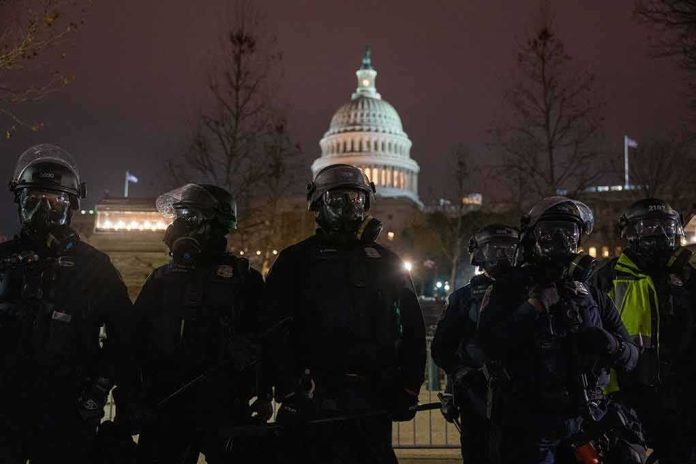
When soldiers in camouflage become part of a city’s daily backdrop, you are not just changing policing tactics; you are rewriting the terms of civilian life and the balance of power that protects it.
At a Glance
- Washington, D.C. has operated under an open-ended National Guard mobilization ordered by the White House with no fixed end date, tied to a presidential determination of “restored” law and order.
- Federal courts have found core elements of this deployment unlawful, sharpening a constitutional fight over D.C.’s home rule and the limits of executive authority in domestic security.
- Empirical evaluations to date find little or no measurable reduction in violent crime attributable to the Guard’s presence, despite substantial cost and civic disruption.
- D.C.’s unique legal status makes the capital unusually vulnerable to federal control; the real dispute centers on purpose, duration, and who may request troops—not whether troops can ever be used.
What an Open-Ended Guard Mission Does to a City
The White House directive that mobilized the D.C. National Guard did something rare in American life: it conditioned the end of a domestic military-security mission on a presidential judgment call, not a statutory threshold or an objective public-safety metric. The order explicitly left the duration open until “conditions of law and order have been restored in the District of Columbia,” and subsequent fact sheets reinforced that the Guard would “remain mobilized” on that same subjective standard. That framing matters. When the mission’s completion depends on the same branch that launched it, inertia is not an accident—it is design.
Layer in operational choices—24-hour rotations, visible patrols alongside local police, and later, universal arming of Guard personnel—and you get a civic environment where military force is not an emergency backstop but a routine presence. Supporters call this deterrence; critics call it normalization. Both descriptions are accurate in their own way, which is precisely why duration and mission scope are the fulcrum of the legal and policy debate.
The Law: D.C.’s Special Status and the Real Lines in Dispute
Washington is not a state; Congress retains ultimate authority even as it has delegated local governance under the Home Rule Act. That hybrid structure has long made the capital an arena where questions of federalism and public order collide. The central legal fight is not whether the federal government can ever use the D.C. National Guard or federalize local resources; it is when and for what purpose, for how long, and at whose request. In practice, those questions are dispositive. Title provisions and the Home Rule framework contemplate limited, specific, and time-bounded uses—especially where the city has not requested aid.
Federal litigation has now crystallized those limits. A district court concluded that deploying the D.C. Guard for generalized crime deterrence without a municipal request exceeded statutory authority and contravened the home-rule powers Congress itself conferred, enjoining further deployment on that basis (with a stay for appeal). That is not a marginal procedural ruling; it goes to the heart of whether an administration can transform an emergency instrument into standing domestic policing. If the judgment stands on appeal, it will mark a clear boundary: presidential discretion cannot substitute for the statutory triggers that protect local self-government and cabin military roles inside civilian life.
Security Payoff Versus Civic Cost
Security policy ultimately rises or falls on outcomes. The administration’s public case leans on activity measures—arrests made, guns seized, task-force operations across “hot spots”—and the symbolic reassurance of uniforms on the street. But activity is not impact. Independent reviews have struggled to find a measurable reduction in violent crime attributable to Guard patrols; one widely cited assessment reported no statistically discernible effect on homicides or serious violence, even as property and nuisance offenses shifted at the margins.
For a city, the opportunity costs are concrete. Guard deployments reallocate resources to a mission for which soldiers are only partially suited—deterrent visibility rather than investigative depth—and they chill normal civic use of public space. The longer that posture persists, the more it blurs the line the Posse Comitatus tradition was designed to keep bright: the military defends the polity; the police police it. Courts have now underscored that the statutes implementing that principle apply in the District too, notwithstanding its federal character.
How We Got Here: Temporary Measures That Linger
American history is littered with emergency authorities that stayed longer than their drafters imagined—internal security powers in wartime, surveillance authorities in the age of terror, border measures recast as public-health tools. D.C.’s Guard mission fits the pattern. It began as a response to an “epidemic of crime,” justified as necessary to protect federal assets and the orderly functioning of government; it then accreted extensions and a support architecture of federal task forces and marked patrols. None of that is facially illegal. The problem is that open-ended use for general deterrence, absent a city request, migrated the mission from emergency to ordinary governance, triggering the legal constraints that federal judges have now enforced.
That arc is not unique to this administration or this city; it is the hazard of any executive-led security expansion. The capital’s special legal status simply made the frictions arrive faster and cut deeper. Advocates who long urged Congress to transfer control of the D.C. Guard to the mayor were not tilting at abstractions; they anticipated precisely this collision between federal prerogative and local consent.
Where Reasonable Disagreement Lives—and Where It Doesn’t
Reasonable people can disagree on the utility of visible military presence. Some residents do feel safer around uniformed patrols; some neighborhoods may experience fewer opportunistic crimes when soldiers and marked units saturate the landscape. Those are legitimate, if localized, benefits. What the evidence does not support is the claim that a prolonged Guard deployment is a reliable lever against serious violence across a complex, dynamic city; the best available evaluations have not found the promised reductions in homicides and shootings.
Nor is there serious legal ambiguity left about the core question tested in court. A president cannot fill the city’s routine policing gap with soldiers for an indeterminate period, absent the statutory predicates that anchor civilian control and home rule. That is not judicial nitpicking; it is the system functioning as designed, ensuring that extraordinary powers do not metastasize into ordinary governance.
What Endures After the Troops Leave
Even if the Guard demobilizes tomorrow, the real legacy will be institutional and cultural. Institutionally, expect Congress to revisit the District of Columbia National Guard Home Rule Act proposals that would move command from the president to the mayor, at least for domestic missions; that reform would not preclude federal mobilization in genuine emergencies, but it would restore the default to local consent and time-limited authority. Culturally, the year-plus of normalized uniforms will linger in expectations—among federal agencies accustomed to a turnkey deterrent tool, and among residents acclimated to a posture that should remain exceptional.
Sources:
theatlantic.com, abcnews.com, apnews.com, katv.com, wtop.com, cnn.com, bbc.com, politico.com