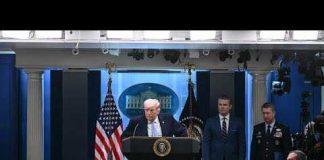
After years of watching allies hedge and “global institutions” stall, President Trump just forced a public reckoning: either help keep the Strait of Hormuz open, or admit you’re comfortable letting Iran choke off the world’s energy lifeline.
Story Snapshot
- Seven U.S. partners issued a joint statement backing a potential U.S.-led effort to secure shipping through the Strait of Hormuz amid Iranian attacks.
- The statement signals political alignment with Washington but stops short of committing specific naval deployments.
- U.S. military operations escalated the next day with what was described as the largest strike package yet against Iranian assets threatening the strait.
- U.K. officials moved from messaging to planning by sending officers to U.S. Central Command to support coalition preparation.
Seven allies sign on—carefully—to a U.S.-led Hormuz effort
On March 19, the United Kingdom, France, Germany, Italy, the Netherlands, Japan, and Canada released a joint statement supporting a potential U.S.-led coalition to ensure safe passage through the Strait of Hormuz. The group condemned Iranian attacks on commercial shipping involving mines, drones, and missiles, and said it was ready for “appropriate efforts” and preparatory planning. The key catch is simple: the statement did not announce concrete naval deployments.
President Trump’s pressure campaign is an essential part of the timeline. Reporting described Trump criticizing allies for reluctance and then seeing a rapid shift toward a unified message. The U.K. reportedly helped bring France onboard after earlier resistance, while Japan joined late ahead of a White House visit by Prime Minister Sanae Takaichi. For voters tired of “all talk, no burden-sharing,” the language is progress—but it also underscores how much of Europe still prefers symbolism to hardware.
Why Hormuz matters: a 21-mile chokepoint with global consequences
The Strait of Hormuz is a narrow passage between Iran and Oman that handles roughly 20% of global oil trade. That fact is why every threat to shipping there becomes a direct pocketbook issue for American families—fuel prices, home heating costs, and broader inflation pressures. The current crisis stems from an escalated U.S.-Iran-Israel conflict in which Iran has effectively blockaded the strait by targeting vessels and threatening transit, stranding Gulf oil and tightening markets.
History shows Iran returns to this leverage point whenever it believes pressure will fracture Western resolve. The region has seen earlier cycles of maritime coercion, from the 1980s “Tanker War” to the 2019 tanker seizures that led to a U.S.-led maritime security initiative. What is different now is the intensity of the disruption described in current reporting and the urgency of coalition-building during active conflict. In practical terms, keeping the strait open is less about theory and more about stopping a hostile regime from pricing energy through fear.
U.S. escalates strikes as allies offer planning—and political cover
On March 20, U.S. forces launched what was described as the largest strike package yet against Iranian assets connected to threats in and around Hormuz, as coalition talk moved from public statements to operational planning. Reporting also said U.K. officers were dispatched to U.S. Central Command in Tampa to support preparations. Separately, intelligence testimony emphasized that Iran’s capabilities have been degraded but not eliminated, meaning the risk to commercial shipping can persist even after major strikes.
The divide between “endorsement” and “deployment” matters for how Americans should read this moment. The joint statement signals seven governments are willing to attach their names to a U.S.-led plan, which helps deter Iran politically and can support intelligence sharing, basing coordination, and diplomatic pressure. At the same time, the lack of announced ship commitments suggests some capitals still want the benefits of stability without the risk and cost of enforcement. That’s a familiar pattern for U.S. taxpayers who have carried outsized burdens for decades.
What to watch next: commitments, rules of engagement, and energy pressure
The next test is whether the coalition becomes a real maritime security operation with ships, aircraft, and clear rules of engagement—or remains a statement designed to ease friction with President Trump. The reporting points to preparatory planning and allied “appropriate efforts,” but the details that matter to deterrence are still unknown: who deploys, where they base, and what actions trigger force. Until those specifics appear, the coalition should be viewed as a framework, not a finished capability.
Americans should also watch how energy pressure is used as leverage, because Hormuz is ultimately about economics as much as military posture. One proposal discussed in coverage involved a policy concept sometimes summarized as “open for all or closed for all,” aimed at denying Iran the benefits of maritime trade if it continues threatening others. Whether such ideas gain traction will shape how quickly Iran recalculates. For households still angry about years of inflation and mismanagement, preventing another externally driven price shock is not optional policy—it’s basic governance.
Sources:
Seven U.S. Allies Back Potential Strait of Hormuz Coalition
Fox News video: Coverage on strikes, coalition, and related testimony