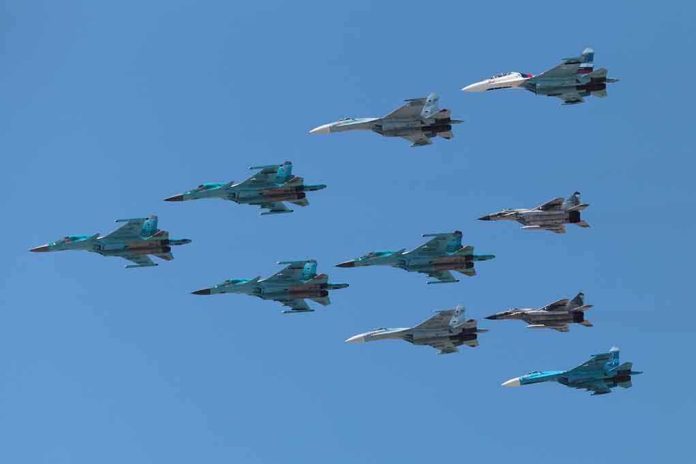
The most durable lesson from Operation Epic Fury is not about target lists or sortie counts; it is that prolonged, high-intensity combat against a missile- and drone-centric adversary made traditional, hub-and-spoke airpower employment too brittle to survive the tempo. Those days are over. The Air Force is retooling around dispersion, layered base defense, and a heavier mix of autonomous and attritable systems because the math of endurance—runways, munitions, and human stamina—demanded it.
At a Glance
- Thirty-eight days of sustained combat against Iran revealed hard limits in concentrated basing, munitions depth, and airbase protection.
- Leadership framed Epic Fury as a pivot point for force design—toward dispersed operations, tougher base defense, and more autonomous/attritable aircraft.
- Defense of airfields under mass missile and UAV attack required constant runway repairs, EOD sweeps, and layered intercepts at unprecedented pace.
- Losses and expenditures exposed industrial bottlenecks; replenishment timelines now shape operational concepts as much as tactics.
What Epic Fury Changed: From Efficient to Survivable
For decades, the Air Force optimized for efficiency: larger hubs, high sortie generation, dense logistics, and exquisite aircraft protected by sophisticated missile defense. Epic Fury upended the trade space. Iran’s salvos forced U.S. units to ride out more than a thousand “Alarm Red” conditions, execute dozens of runway repairs, and conduct hundreds of unexploded ordnance sweeps while keeping combat airpower flowing. Even where Patriot and THAAD batteries performed well, sustained mass strained interceptor magazines and crew endurance—exactly the attritional problem a salvo-centric foe intends to impose. Senior leaders have been explicit that the campaign’s operational intensity will drive changes in how the Air Force presents forces and protects them at scale.
The vector is clear: disperse aircraft and support teams across more locations; harden and deceive what cannot move; and build layered defenses that start outside the fence line and extend down to point-defense and rapid damage repair inside it. This is not a fad. It aligns with decades of analysis arguing that survivability in contested regions rests on distributing risk and complicating an adversary’s targeting and reattack plans.
Base Defense Under Salvo Pressure: Layers, Not Silver Bullets
Epic Fury confirmed what practitioners of air base defense have long taught: there is no single shield. Effective defense integrates three concurrent tasks—controlling the standoff zone, securing the perimeter, and protecting critical assets within the fence—and sustains them under fatigue and damage. In practice, that meant countering reconnaissance and launch platforms before they fired; suppressing infiltrators and one-way UAVs at the base edge; and, when a “squirter” got through, keeping aircraft, fuel, command nodes, and runways alive long enough to fly the next wave.
Two constraints forced doctrinal sobriety. First, magazine depth: every Patriot or NASAMS shot expended a missile that took time—and money—the industrial base struggled to replace. Second, manpower and mobility: security forces, engineers, EOD, and maintainers had to pivot from episodic incidents to an industrial rhythm of repair and recovery under fire. Reports of repeated runway fixes and EOD sweeps while flying the war underscore why lighter, cheaper interceptors, mobile sensors, and small uncrewed air systems for local defense are moving from nice-to-have to standard kit.
Force Design Implications: Disperse, Deceive, and Go Attritable
Dispersed operations are more than parking jets at more bases. They require refactoring logistics, maintenance, command-and-control, and runway recovery for mobility—prepositioned spares, modular fuel, expeditionary arresting gear, compact airfield lighting, and mission command that tolerates intermittent connectivity. RAND’s historic work on bomber dispersal and modern studies on distributed operations converge on the same logic: distribution raises the adversary’s cost of suppression and buys decision-makers time when magazines run low or a hub takes a hit. Epic Fury turned that logic into policy momentum.
Attritable and autonomous systems are the second pillar. When the Inspector General tallied billions in losses and expenditures, including significant UAV attrition, it sharpened an already active conversation: if you will lose aircraft in a contested environment, better to lose cheaper, quickly replaceable ones that still soak up enemy fire, contribute sensing and strike, and reduce demand on exquisite manned platforms. In parallel, the bomber force again proved decisive but finite—useful for rapid strategic effects yet constrained by tanker availability and munitions production cycles. The rebalanced mix points to manned-unmanned teaming, preplanned decoys and spoofers to saturate enemy air defenses, and a tiered magazine approach that preserves high-end interceptors by offloading routine kills to cheaper shooters.
The Munitions and Industrial Base Reality Check
Epic Fury was as much a stress test of American magazines as of Iranian defenses. The campaign consumed advanced munitions at a rate that revealed inventory shortfalls and production bottlenecks—a predictable outcome in theory, now documented in practice. The Pentagon’s own watchdog and external reporting put cost and loss figures in stark relief, including tens of billions in expenditures and attrition across platforms, from tankers to MQ-9s. Strategy cannot be insulated from those facts; operational plans that assume indefinite stocks of interceptors, cruise missiles, and precision glide weapons are fantasies. The Air Force’s post-Epic Fury planning reflects that, privileging concepts that stretch magazines through dispersal, deception, and selective use of stand-in weapons guided by robust ISR rather than defaulting to standoff for every target.
This is not retreat from precision; it is a reframing of how to achieve it at sustainable cost. The ISR-rich opening phase that blinded adversary sensors and leadership nodes remains the template, but sustaining pressure afterward means mixing weapons and effects to husband scarce inventories and shorten adversary reconstitution timelines.
Human Factors: Sustaining the Force Under Continuous Alarm
Airmen kept combat power flowing under conditions that would have paralyzed a less practiced force—repeated alarms, interrupted sleep cycles, EOD clears, and quick-turn maintenance in blast-fragmentation environments. Leadership has already telegraphed that Epic Fury will be treated as a canonical case study in speed, precision, and scale; the subtext is the human system that made it tenable. Expect standardized training packages for expeditionary air base defense teams, fly-away security elements tuned to contested logistics, and decision authority pushed lower so units can reconstitute operations without waiting on reach-back during communications degradation—continuing a doctrinal throughline from earlier integrated defense lessons to today’s distributed concepts.
What Endurance Looks Like Going Forward
Pull the threads together and a coherent future-force picture emerges. Aircraft and support teams disperse across clusters of main and contingency sites. Deception and rapid runway repair create a moving target problem. Layered defenses start outside the wire with active hunts for launchers and spotters, then collapse inward using cheaper interceptors, point-defense guns, and mobile sensors—augmented by small autonomous systems that patrol the base envelope. Munitions plans blend standoff and stand-in, guided by high-confidence ISR, to pace the industrial base rather than outstrip it in week three.
The Air Force did not discover vulnerability in Epic Fury; it discovered its limits of endurance—and how to extend them. In airpower, endurance wins the long game. That is the lesson being operationalized now.
Travel Pool Report # 26 – More quotes from POTUS/GCC meeting
More quotes from POTUS & GCC meeting:
"Operation Epic Fury crippled Iran's Navy. It eliminated it. Actually, they have 159 ships. Every one of them is right now at the bottom of the sea. Eliminated its air force. They…
— White House Press Pool Reports (@WHPressPool) September 22, 2026
Sources:
19fortyfive.com, airandspaceforces.com, aa.com.tr, cbc.ca, dronexl.co, sandboxx.us, usiofindia.org, atloa.org, justsecurity.org, economictimes.indiatimes.com, war.gov, atlasinstitute.org