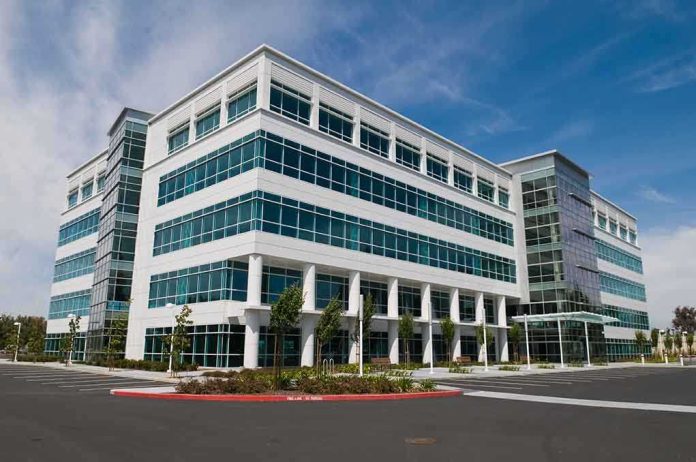
A single armed security officer stopped a lethal attack at a Tampa office complex within minutes—an outcome that is uncommon in workplace shootings and shaped every decision made in those critical first four minutes.
At a Glance
- A gunman rammed onto a corporate campus at lunchtime, shot and killed a woman outdoors, and was fatally shot minutes later by an on-site security guard.
- 911 calls began around 12:11 p.m.; the armed guard engaged the suspect at approximately 12:15 p.m., ending the threat inside a cafeteria.
- Authorities deployed 367 deputies to clear a multi-building site with roughly 3,200 employees; four additional people sustained non-life-threatening injuries.
- While investigators worked to determine motive and any relationship between the parties, the operational sequence and casualty count are consistent across multiple official briefings and outlets.
What happened: a fast-moving assault contained in minutes
Shortly after midday, the suspect steered a small sedan through medians and a secured fence onto the Tampa-area Citibank Center campus, crashing into an outdoor seating area used by employees on lunch break. Exiting the vehicle with a rifle, he shot a woman outside. Moving toward the cafeteria, he encountered an armed corporate security officer who returned fire and shot the suspect; the assailant was transported to a hospital and later pronounced dead. Officials reported one woman killed at the scene, the gunman deceased, and four additional people treated for injuries that were not life-threatening.
The timeline is unusually crisp for such a chaotic setting. Multiple 911 calls started around 12:11 p.m. The armed security engagement inside the cafeteria occurred within minutes, around 12:15 p.m.—a narrow window that often determines whether an incident spirals or is contained. Surveillance footage and bystander video reported by local media show the vehicle intrusion and the suspect moving with a rifle toward the populated area, aligning with the sequence described by Hillsborough County Chief Deputy Frank Losat.
Scale of the response and how a campus gets cleared
Containing a mid-day threat on a corporate campus is a logistics problem as much as a tactical one. Authorities surged 367 deputies—patrol, tactical, and specialized teams—to secure and clear a complex described as six or seven three-story buildings. Approximately 3,200 employees were on-site; that density drives the operational playbook: lock down ingress and egress, establish casualty collection and reunification points, task teams to methodically clear structures, and spin up investigative and victim services tracks in parallel. From first calls to full campus clearance, officials reported roughly two and a half hours, a pace that reflects practiced multi-agency coordination with fire/EMS, federal partners, and private security leadership on scene.
Those numbers are not color commentary; they explain why the casualty count did not climb. A threat interdiction within minutes, followed by disciplined building-by-building sweeps and controlled evacuations, reduces the risk of secondary harm—both from the attacker and from chaos in flight. The presence of trained on-site security who can identify choke points (like a busy cafeteria) and move decisively before law enforcement arrives is the hinge in this case.
What we know—and what investigators appropriately sequence later
The core facts are not in dispute across briefings and coverage: one woman was shot and killed outside; the suspect was shot by an on-site armed security officer and died at the hospital; four others were injured with non-life-threatening wounds; and the campus was cleared after a large-scale response. In the immediate aftermath, officials did not release the identities of the woman or the suspect, a standard practice until next-of-kin notification and initial investigative steps are complete. Descriptions differed early on about whether the attack was “targeted.” Sheriff’s comments suggested a targeted act, while Chief Deputy Losat said investigators were still determining any relationship between the victim and the suspect; both statements can coexist responsibly at that stage, with one a working hypothesis and the other a process note.
This is the correct investigative order of operations: stabilize the scene; preserve and collect evidence; secure interviews across a large witness pool; and only then attach conclusions to motive and relationships that will stand up to scrutiny. The operational record—call logs, dispatch audio, surveillance footage, and forensic reports—will ultimately resolve granularity such as round counts, trajectories, and exact movement within and around the cafeteria. One cautionary sentence belongs here and no more: early witness recollections about shots heard and statuses reported often vary before the official timeline is finalized.
How unusual is a guard-led stop? National data put it in perspective
The public tends to overgeneralize from vivid cases like this. National data suggest that an on-site security guard ending an active-shooter event—especially by fatally stopping the attacker—remains relatively rare. FBI reports cataloging active-shooter incidents show that private security intervention appears in only a small fraction of events in recent years; in 2025, the bureau recorded three such interventions across the country, two at commercial sites, with one attacker killed during the encounter. In the prior year’s accounting, just one incident involved a security guard intervention in the commerce category.
What follows from that base rate is not an argument against trained, armed security; it is a reality check about what typically ends these incidents. Many still conclude with law enforcement engagement, shooter suicide, or flight. Where security teams are present, practiced, and empowered—as on this Tampa campus—their proximity can compress the most lethal minutes before police arrive. That proximity is not a guarantee; it is a capability that must be built deliberately in policy, training, and coordination with local agencies.
🚨 Shooting at Citibank's office complex in Tampa, Florida 🇺🇸
2 dead including the suspect, 4 hurt (non-life-threatening). 367 deputies cleared the building. Police call it "a targeted incident." 🙏
When will this stop?#Tampa #Citibankhttps://t.co/bbbaYTUTE0
— Keiwai_C (@keiwai_c) November 5, 2026
Operational lessons for workplaces and security teams
Three elements stand out. First, access-hardening slows but does not always stop a vehicle-borne breach; layered barriers, vehicle-calming design, and monitored choke points matter because they buy seconds, and seconds are life. Second, the guard’s rapid interdiction underscores the value of scenario-based training that blends de-escalation judgment with immediate armed response protocols—the cafeteria engagement occurred on an accelerated clock. Third, coordination between private security and law enforcement must be pre-negotiated: common radio channels or bridging, a unified command model familiar to both sides, and joint exercises that rehearse building clearances and reunification sites. Tampa’s two-and-a-half-hour full-campus clearance with thousands present suggests that groundwork was in place.
Why this incident will anchor future planning
For corporate campuses, this is a case study in the best and worst minutes of workplace security. The worst: a determined attacker used a car as a breaching tool and a rifle to kill a woman in a crowded lunchtime setting. The best: an on-site professional ended the attack within minutes, and a large agency presence executed a measured clearance without compounding the harm. Nationally, security-led stops remain the exception rather than the rule—but when they happen, they look like this: proximity, training, decisiveness, and integration with public safety response. Those are actionable levers, and they travel well from one campus to the next.
Sources:
washingtontimes.com, wtsp.com, cbs19.tv, cnn.com, tcpalm.com