
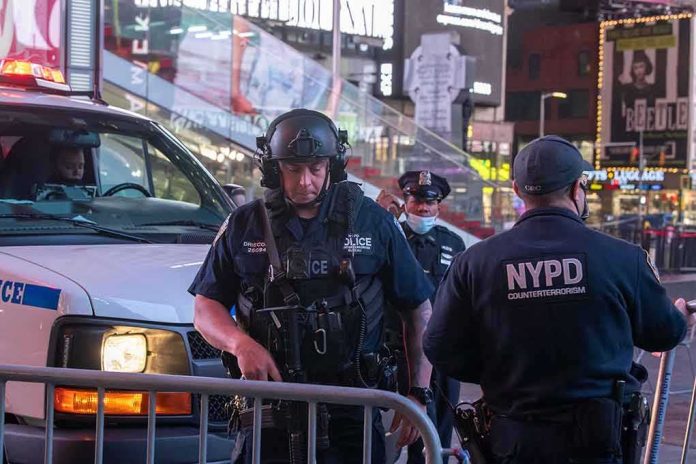
A woman followed a 26-year-old Jewish man through Midtown Manhattan’s Diamond District and stabbed him in the back before vanishing into the Fifth Avenue crowd.
Quick Take
- A man wearing traditional Jewish clothing was followed and stabbed near Fifth Avenue and West 47th Street during evening rush hour.
- The New York Police Department (NYPD) Hate Crime Task Force is investigating the attack as a possible bias crime.
- The victim was treated at Bellevue Hospital for a non-life-threatening injury and is expected to recover.
- No suspect has been publicly identified or arrested as of the latest reports.
What Happened on Fifth Avenue
The attack unfolded near 580 Fifth Avenue, in the heart of Manhattan’s Diamond District. Investigators believe the suspect followed the victim, a 26-year-old man dressed in traditional Jewish garb, before he felt a sharp prick in his lower back. Multiple reports identified him as a member of the Chabad-Lubavitch community from Crown Heights. He was taken to Bellevue Hospital, where doctors described his wound as stable and non-life-threatening.
Witnesses and police accounts describe a woman speaking Russian who made harassing remarks toward the victim before he tried to walk away. She allegedly followed him anyway and struck from behind. CBS New York reported this sequence of events, which investigators say points to a targeted encounter rather than a random collision in a crowded tourist area. The suspect has been described only as a woman in her 30s or 40s, leaving a wide net for police to search.
Hate Crime Task Force Takes the Case
The NYPD’s Hate Crime Task Force is now leading the investigation, treating the stabbing as a possible bias-motivated attack. That classification does not mean investigators have proven intent. It means detectives see enough evidence, the victim’s visible Jewish identity, the reported harassment, and the targeted pursuit, to formally pursue the bias angle rather than file it as a routine assault.
Manhattan Shomrim, a community safety patrol that works closely with Jewish neighborhoods across the city, is assisting police in the search for evidence. The group publicly asked nearby businesses and pedestrians to turn over storefront security footage, dashcam video, and cellphone recordings from the time of the attack. That kind of grassroots canvassing has cracked open similar Manhattan cases before, and it gives detectives a faster path to identifying the suspect than waiting on official channels alone.
An Unknown Weapon and Lingering Questions
Exactly what the suspect used remains unsettled. The victim told police he believed he was struck with a syringe. Police and medical sources have instead described it more cautiously as an unknown sharp object. Until investigators test any recovered item for trace evidence or biological material, the public won’t know whether a needle, blade, or something else caused the wound. That detail matters for building a criminal case, not just for headlines.
A caveat belongs here: police have not confirmed an arrest, named a suspect, or officially ruled this a hate crime under New York law, which requires proof that bias motivated the underlying offense. The investigation remains open and preliminary.
A City Already Grappling With Antisemitic Violence
This attack lands against a troubling backdrop. New York City Police Department data showed that antisemitic incidents made up more than half of all confirmed hate crimes in the city for much of 2026, even as overall violent crime fell to record lows. Jewish residents account for roughly one in ten New Yorkers, yet they were targeted in the majority of bias-motivated offenses tracked by the department this year.
🚨 HATE CRIME INVESTIGATION: Manhattan Shomrim and the NYPD Hate Crimes Task Force are actively investigating a stabbing that occurred today around 5:45 PM at 47th St. and 5th Ave.
We are asking for the public's assistance. If you were in the Diamond District/Midtown area… pic.twitter.com/EELGa2ViXO
— Manhattan Shomrim Safety Patrol (@msspshomrim) October 22, 2026
Those numbers don’t prove what motivated this particular attacker. But they explain why police moved quickly to loop in the Hate Crime Task Force rather than treat this as an isolated street assault. When a pattern this consistent shows up in city data, every new incident involving a visibly Jewish victim gets scrutinized through that lens, and reasonably so.
What Comes Next
Detectives still need to identify the suspect, recover usable footage, and determine what object was used. A clean identification would let prosecutors decide whether to pursue hate crime charges under New York’s penalty-enhancement statute, which requires showing bias was a substantial motivating factor behind the underlying crime. Until then, the public knows the outline of what happened on Fifth Avenue. The full picture, including who did it and why, is still being assembled by investigators working the case on the ground.
Sources:
pjmedia.com, nypost.com, abc7ny.com, israelhayom.com, israelnationalnews.com