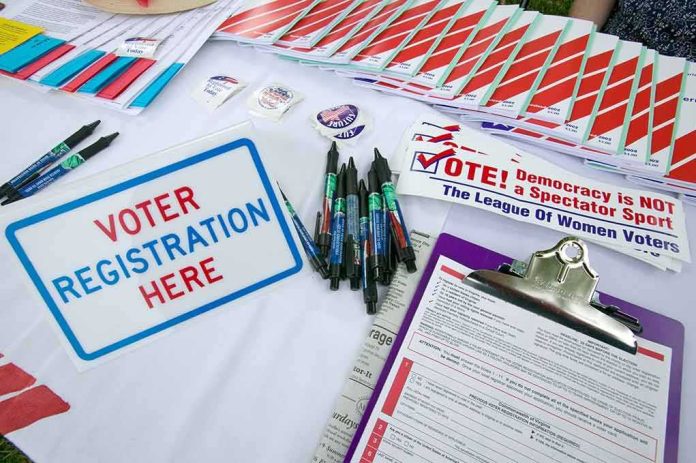
California lets eligible citizens register to vote without a driver’s license or Social Security number, then verifies later with a state-assigned identifier.
Story Snapshot
- California assigns a unique voter number if you lack a license or Social Security digits.
- Most voters are not asked for ID at the polls; first-time exceptions apply.
- First-time by-mail registrants who omitted ID numbers may need documents like a utility bill.
- Officials say databases match records to verify identity and maintain the rolls.
California’s Registration Rule Puts Verification on the Back End
California’s voter registration form asks for a driver’s license or state ID, or the last four Social Security digits. If an applicant has none, the process does not stop. The county assigns a unique voter number and processes the application. State guidance repeats this point across pages and FAQs. The design signals a policy choice: do not block sign-ups on the front end; verify with databases and signatures as the record matures. That approach reduces friction but raises trust questions for many readers.
California regulations back the workflow with specific matching rules. The statewide system compares name and birthdate against Department of Motor Vehicles files when a license or state ID exists, and checks Social Security digits against federal records when provided. If the person lacks both numbers, the state assigns a unique identifier so the system can track and validate that registrant across elections. Critics see room for gaps; administrators see a compliant, auditable trail aligned to federal law.
What Happens at the Polls: Rare ID Checks, Limited Triggers
Most California voters do not show identification at polling places. The state’s materials state that in most cases, no ID is required before casting a ballot. That does not mean no one shows documents. A first-time voter who registered by mail and did not provide a driver’s license, state ID, or last four Social Security digits may be asked for identification. The acceptable list includes a recent utility bill, a sample ballot booklet from the county, another government document, a passport, driver license, state ID, or student ID.
That list undercuts casual claims that any random card works. A gym card or insurance card does not appear on the official list. The line is clear: non-photo documents linked to a residence or sent by a government source can meet the rule for those flagged first-time cases. From a conservative, common-sense lens, this is a light-touch screen. It checks some tie to a real person at an address, but it is far from a strict, universal photo-ID system at the polls.
The Integrity–Access Tradeoff Is the Point, Not a Side Note
Election officials defend the model as layered verification. They cite database checks with the Department of Motor Vehicles and the Social Security Administration. They also point to death and felony data updates and first-time voter ID triggers for federal elections. Supporters argue the system handles the rare edge cases while avoiding barriers for lawful voters. Skeptical readers counter that trust rises when everyone shows the same ID at the same time, every election, with fewer exceptions.
In Nevada, a voter ID citizen initiative passed 73%–27% in 2024. Nevada requires constitutional amendments to win two successive general elections, so it is on the 2026 ballot again. If it passes a second time, Nevada leaves the no-ID list. 14 states plus DC are on that list.…
— Terry Agar (@Tassas22) September 2, 2026
Here is the bottom line on the “400,000 without ID” idea: California’s own pages say people without those numbers can register and get a state identifier, and most voters are not asked for ID at the polls. That combination fuels concern. Yet the record we have today is mostly procedure, not proven abuse at scale. If you want firmer answers, ask for the counts that matter: how many unique identifiers the state issued, how many first-time voters were flagged, how many failed to cure with documents.
Sources:
sos.ca.gov, elections.cdn.sos.ca.gov, voteriders.org, ballotpedia.org