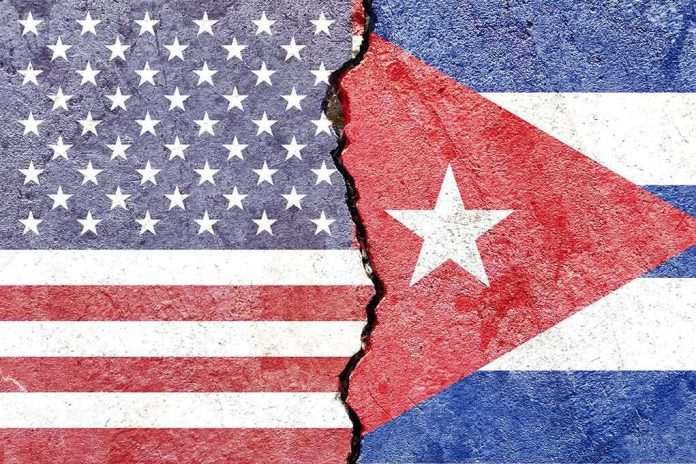
When leaders invoke “freedom is coming to Cuba,” they are not merely predicting events; they are activating a long-standing U.S. policy lever that links pressure to political change. To understand what such a pledge can and cannot deliver, you have to trace the machinery behind it: sanctions engineered to constrict fuel and finance, an electrical system already at the edge, the legal architecture that ties relief to regime transition, and the Cuban state’s durability amid recurring crises.
At a Glance
- President Trump’s UN remarks label Cuba a failed state and promise “freedom will be coming to Cuba,” aligning rhetoric with an escalated pressure campaign on fuel and finance.
- Cuba’s blackouts and scarcity are not single-cause: aging generation assets, dependence on imported fuels, and external restrictions reinforce one another.
- U.S. law hardwires regime-change incentives; the Helms-Burton framework conditions lifting sanctions on a transition or democratically elected government.
- Havana rejects the failed-state charge and frames U.S. policy as coercive and sovereignty-violating; Cuban officials staged a walkout at the UN in protest.
What Trump Said, and Why It Matters for Policy
From the podium at the United Nations, President Trump described Cuba as “an absolutely failed state,” predicted it “will fall,” and pledged that “freedom will be coming to Cuba.” He paired that language with a claim that his administration is pursuing a “fundamental change in the situation in Cuba”. Taken together, this is more than flourish. It publicly binds Washington’s aims—political change in Havana—to a pressure toolkit that has recently centered on choking the island’s fuel lifelines and complicating hard-currency flows. Cuban officials walked out of the UN chamber during the remarks, a visible rejection that underscored the stakes and the adversarial framing.
The objective in such moments is twofold: degrade the regime’s ability to manage daily life while signaling to allies and fence-sitters that change is imminent, thereby shaping behavior in anticipation of a transition. That signaling has real-world effects—credit tightens, counterparties hesitate, and suppliers demand premiums or walk away—quite apart from formal embargo rules.
The Mechanics of Pressure: Fuel, Power, and Cascading Scarcity
Modern Cuba runs on imported hydrocarbons. When fuel tightens, the knock-on effects are immediate: thermal plants derate or trip, grid stability erodes, and blackouts ripple through logistics, water pumping, refrigeration, and clinical care. In September, the country suffered total or near-total grid collapses, leaving millions without power; reporting tied the fragility to aging generation, transmission failures, and acute fuel scarcity amid a U.S. campaign that has largely blocked oil shipments. Independent coverage has counted these as part of a string of nationwide or near-nationwide outages this year, not an isolated anomaly.
None of this is monocausal fatalism. Cuba’s power fleet is old, maintenance capital is thin, and reserve margins are shallow; geopolitical pressure amplifies a preexisting vulnerability rather than creating it from whole cloth. In practice, though, policy intent and engineering limits converge: every constrained shipment increases forced outages, every outage compounds economic loss, and every loss narrows the regime’s room to maneuver. That feedback loop is exactly why fuel has become the fulcrum of strategy.
The Legal Architecture: Why U.S. Rhetoric Tracks Sanctions Design
Washington’s sanctions regime is not a generic trade dispute; it is a conditional architecture meant to incentivize political transition. Under the Helms-Burton Act, the president cannot simply lift the embargo at will; statutory relief is tethered to the emergence of a transition or democratically elected government meeting specified criteria. That linkage makes “pressure until change” not just a slogan but the operative structure of policy. It also explains the cadence of escalatory measures—new designations, tightened energy targeting, and warnings to third-country suppliers—that reinforce the sense of an approaching hinge point.
This legal scaffolding matters for timelines and claims. If freedom is coming by way of negotiated opening, it will require verifiable political steps in Havana that unlock statutory flex; if it is coming via collapse, it will follow the sequence we have seen elsewhere when fuel, finance, and legitimacy unravel. Either path runs through the constraints Helms-Burton codifies.
Havana’s Rejoinder: Sovereignty, Coercion, and the Walkout
Cuban leaders reject the failed-state characterization and argue that Washington is using collective punishment to force internal change. President Miguel Díaz-Canel called the policy a “genocidal economic war,” insisting Cuba will defend sovereignty and is not a threat to the United States. The Cuban delegation’s walkout during the UN speech served as an on-record repudiation of the framing and the ultimatum logic behind it. Independent UN human rights experts have likewise criticized new U.S. sanctions as coercive measures aimed at imposing change in a sovereign state.
These counter-claims do not erase the material picture of outages, shortages, and migration pressure. They do, however, contest the attribution: for Havana, scarcity is externally manufactured; for Washington, it is the predictable consequence of a command economy that refuses reform. Both narratives capture part of the truth; the crisis is layered, and causation runs both through internal mismanagement and external constraints.
How We Got Here: From Endurance to Exhaustion
For decades, Cuba balanced an embargo by building parallel lifelines: Soviet support, then Venezuelan oil-for-services arrangements, tourism, and remittances. Each one has frayed. The power sector’s capex backlog grew as access to finance narrowed; parts inventories thinned; outage rates rose. The result by 2026 is a system many Cuban and regional analysts describe as chronically destabilized by deteriorated thermal generation, tight fuel supply, and a still-insufficient energy transition. Layer sanctions that specifically target energy logistics and service companies, and the margin for error vanishes.
It is in this context that sweeping claims about imminent “freedom” acquire their force. They are not forecasts based on a single lever being pulled; they are bets that the compounded stresses—technical, financial, and political—have breached the regime’s adaptive capacity.
What “Freedom Will Be Coming” Could Mean in Practice
Strip the slogan to its operational scenarios and three paths appear. The first is a negotiated stabilization-for-reform trade: limited fuel access and targeted sanctions relief in exchange for verifiable political steps and market opening. The second is a controlled transition driven by internal elites seeking to preserve order while meeting minimal conditions for international reintegration. The third is uncontrolled failure—deeper blackouts, liquidity seizures, and state capacity erosion—after which any transition is more costly and less predictable. The Helms-Burton trigger points and the energy system’s realities shape all three.
Which path is most plausible? The facts support a confident statement that pressure is working—in the sense that it has sharply reduced Cuba’s energy resilience and narrowed policy options. They do not, by themselves, settle whether the end state is negotiated reform or sudden break. That outcome turns on actors inside Cuba more than on speeches in New York.
How to Read the Next Moves
Two metrics are more probative than rhetoric. First, fuel balance sheets: confirmed tanker arrivals, sourcing diversification, and net usable inventory determine blackout depth and economic throughput. Second, statutory and diplomatic signals: any calibrated license activity, humanitarian energy corridors, or explicit transition benchmarks would indicate whether Washington is tilting toward managed change rather than collapse-by-attrition. Keep an eye as well on Havana’s willingness to formalize reforms that unlock sanctions relief; absent that, the attrition cycle continues under existing law.
Sources:
military.com, en.cibercuba.com, reuters.com, bbc.co.uk, cnbc.com, thehill.com, news.un.org, cubastudygroup.org