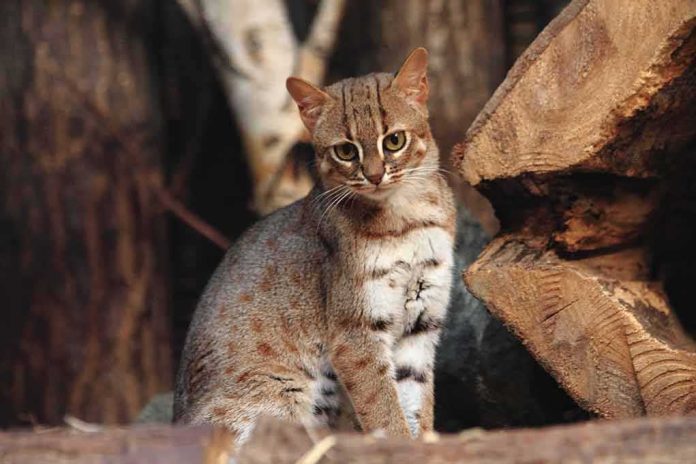
A tiny spotted wildcat in Bolivia has been confirmed as a brand-new species, the first such feline named in more than a century.
Story Highlights
- Scientists identified Leopardus tilcayo, a small wildcat from Bolivia’s Yungas cloud forest.
- Researchers say this is the first newly named living cat species in over 100 years.
- Genetic analysis and museum samples helped confirm it is distinct from known tiger cats.
- Only two documented individuals informed the first descriptions, including one from a refuge.
What Scientists Found In Bolivia’s Cloud Forest
Researchers working in Bolivia described a new wildcat species called Leopardus tilcayo. The cat lives in the Yungas cloud forest on the eastern slopes of the Andes near La Paz, an area known for dense, wet forests and steep valleys. Reports describe a small, lean body, rounded ears, and a light brown coat with irregular rosettes. The animal weighs only a few pounds and measures about a foot and a half long, making it one of the smallest wild cats in the Americas.
Scientists and local partners did not rely on a single photo or rumor. They gathered evidence from two living cats and from preserved bones and skins stored in museums. One individual was photographed in the wild. Another was brought to a Bolivian wildlife refuge as a kitten, where teams could observe it closely and collect samples. These steps let the team compare the cat with known species in the same genus, which includes other small, spotted tiger cats.
How The Team Confirmed A New Species
Research groups compared the cat’s DNA to that of related species across South America. They used genomes from dozens of cats and filled gaps with genetic material drawn from older museum specimens. This broad comparison helped place Leopardus tilcayo on the cat family tree, separate from other tiger cats found in Brazil, Peru, and Colombia. The analysis supports the claim that this lineage split off more than one million years ago.
Several outlets report a divergence time around 1.4 million years, which helps explain the physical differences seen in the coat and skull shape. The study places the tilcayo in a cluster apart from Leopardus pardinoides and Leopardus tigrinus, both spotted tiger cats known to science. Together, the genetic and physical markers make a strong case that this Bolivian cat is a distinct species, not a local variant of a known one.
Why This Matters Beyond Biology
Scientists say this is the first newly named living cat species in more than a century. That is rare in modern zoology and highlights how much biodiversity hides in plain sight. It also shows the value of museum collections and field partnerships with local communities. Identifying a new species can drive support for habitat protection, especially in cloud forests facing logging, mining, and road building pressures.
The story also speaks to a broader public worry: important work often struggles for funding and attention while policy fights drag on. Here, basic research, careful fieldwork, and local knowledge produced a clear win for science and conservation. The finding points to a simple truth that resonates across politics: when institutions focus on results and share data, they can still deliver something real and good for the public and the planet.
What We Know And What Comes Next
Descriptions so far rely on two individuals and museum samples, which is common in early species work. Scientists will now try to map where the cat lives, how many exist, and what risks it faces. Those steps guide smart choices on land use, hunting rules, and refuge support. Early reports place the tilcayo in the Bolivian Yungas, but surveys may find it in nearby valleys or higher slopes as teams add camera traps and genetic sampling.
Scientists in Bolivia have identified and named a previously unknown wild cat species — the first such discovery in a century. The 10-year-old wildcat, named Tigrino, is one of two known living members of the newly identified Leopardus tilcayo.
Here's more of its story.… pic.twitter.com/2YM1f6AGCm— CGTN Latin America (@CGTNLatAm) September 20, 2026
For readers, this is a reminder that discovery still happens, even when the news feels stuck on conflict. A three-pound cat with dappled fur made it onto the world’s species list because people did the slow, careful work. If leaders in Washington applied the same focus to hard problems at home—on energy costs, border systems, and wasteful spending—citizens across the aisle might feel less ignored and more hopeful about what shared effort can achieve.
Sources:
es.wikipedia.org, cbc.ca, livescience.com, timesofindia.indiatimes.com, livenowfox.com