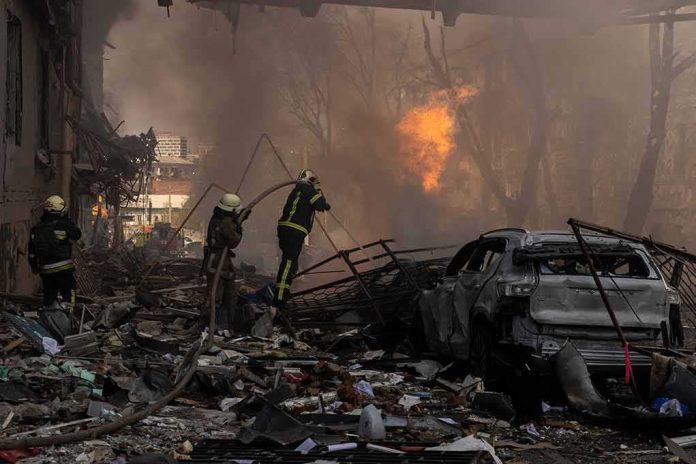
Striking a jet-fuel node next to a capital-city airport is not just a battlefield gesture; it is a bid to impose cost and spectacle at the very heart of a rival’s logistics and national image—exactly what Riyadh experienced when flames and a towering black plume rose beside King Khalid International Airport.
The Short Version
- Flames and a large column of black smoke were documented near Riyadh’s main airport as Saudi authorities issued and then lifted citywide danger alerts.
- Imagery and eyewitness accounts pointed to a fire at or adjacent to airport fuel storage, with flights disrupted and residents reporting booms in the capital.
- The incident tracks with a renewed Houthi campaign against Saudi energy and aviation assets using drones and missiles in the summer-to-fall escalation.
- Targeting airport fuel infrastructure leverages distance, visibility, and economic leverage—aimed as much at deterrence narratives as at physical damage.
What happened near Riyadh’s airport—and what we can say with confidence
On a Saturday marked by overnight danger alerts in Riyadh, residents heard booms and then saw a massive plume rising in the direction of King Khalid International Airport. Reuters journalists and cameras documented flames and thick, black smoke, with footage situating the fire in proximity to the airport complex. Airport operations were disrupted, with delays and cancellations reported as civil defense ultimately issued an all-clear later in the day. Other outlets, citing on-the-ground reporters and images, described firefighters working near a fuel tank bearing an Aramco logo and a smoke column that was plainly visible from major roadways approaching the terminals. The combination—sirens, flight disruption, and burning fuel assets—follows the pattern of prior Houthi strikes that aim for both practical disruption and symbolic reach into Saudi core infrastructure.
While official attribution can lag tactical events in this conflict, the incident occurred amid a documented ramp-up in Houthi operations against Saudi energy and aviation targets across multiple cities, and after explicit Houthi threats to expand their target set if the conflict escalated. In the preceding weeks, the group publicly claimed attacks on Aramco facilities and regional airports; independent and Saudi-linked reporting chronicled damage at fuel depots and interruptions at airbases and civilian terminals in the south and west of the kingdom. The weekend of the Riyadh fire arrived against that backdrop—an operational cadence and target portfolio consistent with what Riyadh experienced near its primary airport.
How this kind of strike works: range, guidance, and the physics of fuel
Houthis have iterated a mixed arsenal—long-range one-way attack drones, cruise-class weapons, and ballistic missiles—that trades exquisite accuracy for reach and volume. Jet-fuel storage, unlike a hardened runway, is a comparatively soft, high-payoff target: the tanks are stationary, visible to open-source reconnaissance, and, if breached or ignited, produce the kind of billowing smoke that ensures both operational and psychological effects. A small warhead or even incendiary components can force outsized responses—firefighting, flight ground-stops, and emergency inspections—which ripple through airline schedules and oil-market headlines. That asymmetry explains why aviation-adjacent energy nodes repeatedly appear on Houthi target lists alongside airbases: they are easier to hit than moving aircraft and harder for authorities to downplay because the combustion itself becomes the story.
Defensively, Saudi Arabia layers radar, Patriot-class interceptors, point-defense systems, and counter-drone capabilities around key cities and energy corridors. These defenses complicate ballistic and cruise trajectories but cannot hermetically seal a national airspace—especially against low-altitude, small cross-section drones that can slip past radar horizons or arrive in swarms to saturate interceptors. In such an environment, prudent operators emphasize dispersion (smaller, separated tank farms), blast walls, fire breaks, rapid foam response, and redundancy in fuel supply lines to airports. Nevertheless, even a contained tank fire is visually dramatic and operationally disruptive—precisely why attackers seek it and defenders can only ever reduce, not eliminate, the risk.
Why Riyadh, why now: the strategic logic of airport-adjacent targets
The Houthis telegraph their intent: striking energy and aviation infrastructure projects coercive leverage against Saudi decision-making while signaling capability depth to domestic and external audiences. In the weeks leading to the Riyadh incident, the group escalated attacks that reached beyond border regions, claiming hits on Aramco facilities and airports and prompting Saudi counterstrikes—an action-reaction cycle that has defined their contest since 2015, with episodic lulls and renewed bursts of range and ambition. Hitting near the capital carries three dividends for the attackers. First, it demonstrates reach past the layered defenses of frontier cities. Second, it magnifies economic messaging by touching nodes tied to passenger mobility and jet-fuel logistics. Third, it compels Saudi authorities to show both competence and restraint—quickly extinguishing fires and restoring service without conceding vulnerability—which is a difficult balance to strike under the glare of viral videos and commercial flight-tracking dashboards.
For Riyadh, these episodes raise two intertwined concerns. The immediate one is operational continuity: keep civil aviation moving and isolate any damage to stand-alone tanks or transfer manifolds. The medium-term concern is deterrence credibility—convincing would-be adversaries that the marginal benefit of a spectacular strike is outweighed by the costs. Achieving that credibility typically blends quieter hardening projects, visible intercept successes, and calibrated retaliation. But the Houthis’ arsenal, replenished and iterated over years, has shown enough survivability against interceptors to retain coercive value even when most inbound threats are defeated.
Where this incident fits in the broader campaign against Saudi energy and aviation
Over the late summer and into September, the conflict moved from simmer to boil: Reuters and regional outlets recorded Houthi claims of successful strikes on Aramco sites in Jizan and Yanbu and on airports in Najran and Abha, alongside satellite-aided analyses of damage at fuel depots and military facilities. Saudi responses included air operations against Houthi positions, while Gulf diplomatic efforts stuttered in parallel. The Riyadh airport-adjacent fire sits on that continuum and underscores a key vulnerability—Saudi Arabia’s need to protect not only oilfield hubs and export terminals, but also the ancillary energy infrastructure that sustains mobility in its urban heartlands. The country’s production geography—fields concentrated in the east, export terminals along the coasts, consumption nodes inland—presents a sprawling protection puzzle that adversaries probe opportunistically.
The market implications follow familiar channels. Even modest damage to visible assets near marquee infrastructure can jolt risk premiums and complicate airline and logistics planning. The signal sent by a blaze next to a capital-city airport is less about net barrels offline and more about perceived freedom of action by the attackers. If they can ignite a tank here, they can try again elsewhere. That perception, not just the physical damage, is what Saudi planners must contest through resilience measures and carefully framed public communication.
Fire at Riyadh's King Khalid International Airport fuel depot disrupts flights after Houthis claim missile and drone attack. Saudi authorities have not confirmed the cause.
Air-raid alerts for Riyadh and Al-Kharj ended with an all-clear at 00:42 UTC on 19 September, but… pic.twitter.com/xQywuRL7t4
— HeyDay News (@heyday_news) September 20, 2026
A realistic read on consequence: resilience, not invulnerability
Saudi civil defense has become faster and more practiced at suppression and restoration; airport fire brigades train precisely for fuel-fed blazes, with pre-positioned foam and mutual-aid support. Those competencies limit casualty risk and compress downtime, which matters enormously in aviation and energy markets that price disruption in minutes. Yet resilience is not the same as invulnerability. As long as an adversary can loft even a handful of accurate or lucky munitions to metropolitan range, high-visibility assets like airport tank farms will remain tempting. Expect incremental hardening—more dispersion, revetments, remote-operated isolation valves—and continued emphasis on intercept density around critical nodes. Expect, too, the rhythm we saw in Riyadh: alerts, booms, a plume, then a return to service. It is how twenty-first century stand-off warfare manifests in cities built for commerce, not combat.
Sources:
thegatewaypundit.com, reuters.com, news24online.com, english.ahram.org.eg, france24.com, wionews.com, timesofindia.indiatimes.com