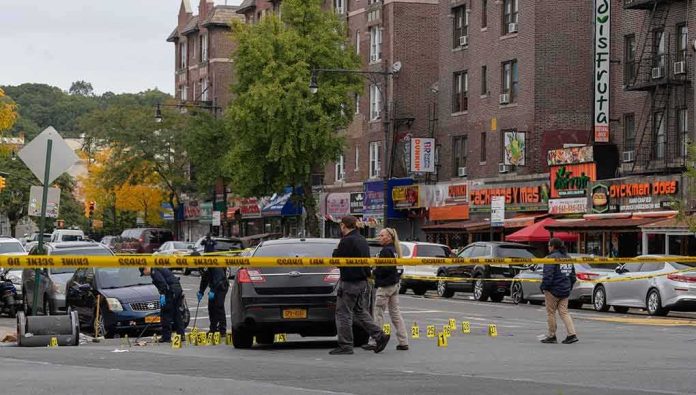
Police shot and killed a man in Boyle Heights after he advanced on officers with a bladed tree-trimming pole, raising fresh questions about crisis response and public safety.
Story Snapshot
- LAPD says the man ignored commands to drop a pole saw and kept advancing before the shooting.
- Reports describe an 8–10 foot pruning pole with a 10–12 inch serrated blade.
- Officers tried to reposition to create distance before firing, police said.
- LAPD and prosecutors opened a formal investigation with body-camera review.
What Police Say Happened on Gillette and Bridge
Los Angeles police officers responded Monday morning to Boyle Heights after reports of a man with a metal pipe. Police say they found a man holding a long pruning pole with a serrated blade. Officers ordered him to drop it. Police report he failed to comply and kept moving toward them. Officers tried to redeploy to increase space, then one officer fired, striking the man. The shooting occurred near Gillette and Bridge on September 7, 2026.
Police and local outlets reported the object was not a stick but a pole saw. Descriptions said it was eight to ten feet long with a ten to twelve inch serrated blade at the end. Police said they recovered the tool as evidence at the scene. No officers or bystanders were reported hurt. The Los Angeles Fire Department transported the man, who later died, according to initial reports from the area.
How the Call Evolved From “Pipe” to “Pruning Pole”
Dispatchers first sent officers to a “man armed with a metal pipe,” which can shape how police approach a scene. Later reports from the scene described a tree-trimming tool with a blade. That shift is common when early 911 details give way to confirmed items at the scene. The Los Angeles Police Department said its Force Investigation Division and the District Attorney’s Office are reviewing body-worn camera video and interviewing witnesses.
Investigators often take days or weeks to release full videos, reports, and autopsy results. In this case, police had not released the names of the man or the officers in the first wave of coverage. Reporters noted that some nearby cameras were not recording because of an internet outage, which may limit third-party video. These factors can slow public review of exact distance, timing, and commands.
Why This Case Fits a Larger Los Angeles Pattern
Recent Los Angeles Police Department shootings often involve people holding sharp or heavy tools during an apparent mental or behavioral health crisis. A Los Angeles Times analysis found that from 2018 on, about twenty-seven percent of police shootings involved edged weapons, and more than sixty percent of those people died. City and station reports also show recent spikes in officer-involved shootings across Los Angeles.
#BREAKING: LA Fire says a suspect was transported to the hospital with a gunshot wound after the LAPD responded to reports of a man armed with a pipe in Boyle Heights Monday morning. https://t.co/bX0OmaLKms pic.twitter.com/P8YD08T4UV
— KTLA (@KTLA) September 7, 2026
Those numbers fuel a debate that crosses party lines. Many residents want faster, safer crisis response. They want police to stop violent threats, but they also want options that do not end in death when a person is in crisis. Police say they face split-second dangers from long blades or heavy poles that can reach past standard tools. Departments train on distance, shields, and less-lethal options, but not every street scene allows time or space.
What Comes Next in the Boyle Heights Investigation
Investigators will likely sync body-camera video with 911 audio and witness interviews to confirm commands, distance, and the man’s movements. They will examine the recovered pole saw and map shots, casing locations, and blood drops. The District Attorney’s Justice System Integrity Division will review the evidence and issue findings. That process has cleared some past cases as lawful self-defense when video and forensics supported the officers’ account.
For the neighborhood, this case will test trust in the system. People want safer streets and also fair, careful use of force. Clear video, a timeline, and a prompt public report can help. The city has pledged more mental health teams and better training for non-firearm threats. The question is whether those tools reached this corner of Boyle Heights in time—and what must change so the next call does not end the same way.
Sources:
nypost.com, ktla.com, abc7.com, mynewsla.com, cbsnews.com, latimes.com