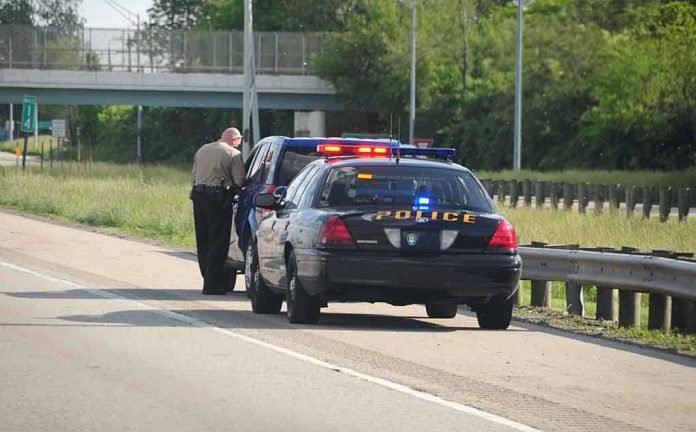
When officer shootings unfold during a “routine” traffic stop, it is not an aberration but a recurrent danger point in American policing; the Teller County incident west of Woodland Park—two Colorado State Patrol troopers shot during an attempted stop, followed by a fast-moving search and a suspect in custody—fits a well-documented pattern and illustrates how quickly a road-side contact can turn into a multi-agency critical incident.
At a Glance
- Two Colorado State Patrol troopers were shot around 7:15 a.m. during an attempted traffic stop on U.S. 24 near milepost 286, west of Woodland Park; one suffered serious injuries and one had minor wounds.
- Both troopers reached the hospital on their own; authorities launched a manhunt, issued a shelter-in-place for nearby subdivisions, and circulated a blue Subaru Impreza suspect-vehicle description.
- State and local agencies later reported the suspect and vehicle were located and the suspect was taken into custody; the shelter-in-place was lifted.
- Traffic stops are a frequent setting for officer shootings nationally, a risk profile borne out in federal analyses of line-of-duty shootings.
What Happened: The core facts are clear and consistent
Shortly after daybreak, at roughly 7:15 a.m., an attempted traffic stop on U.S. Highway 24 near milepost 286—west of Woodland Park in Teller County—turned violent. Two Colorado State Patrol troopers were shot during the encounter. Across multiple outlets citing official statements, the injury profile is consistent: one trooper sustained serious wounds; the other suffered minor injuries. Both made it to a hospital by their own means, a detail that aligns with the assessment that, while one trooper’s wounds were significant, both were stable enough to reach care without on-scene transport.
Authorities moved quickly from incident response to area containment. They pushed a description of the suspect and vehicle to the public—a blue Subaru Impreza hatchback with obscured or missing plates and a male driver with shoulder-length brown-blond hair and facial hair—and ordered residents in Westwood Lakes and adjacent areas to shelter in place as the search widened. Within hours, state investigators reported the suspect and vehicle had been located and the suspect was in custody; the shelter-in-place was lifted accordingly. Governor Jared Polis publicly condemned the shooting and praised the interagency apprehension.
How a roadside stop escalates: mechanics of risk on U.S. 24
Traffic stops begin with an asymmetry of visibility and readiness. The motorist knows who is in the vehicle, what is concealed in the cabin, and what the plan is; the officer is reading the scene in fragments—vehicle behavior, plate status, occupant movements—while dividing attention between radio traffic, situational cues, and the officer-safety choreography of positioning, approach angle, and communications. On a corridor like U.S. 24 near Woodland Park, terrain and sight lines can limit cover and back-up speed; once a driver chooses to produce a weapon instead of documents, the encounter compresses into seconds.
Initial public descriptions here centered on an Impreza with obscured plates—an indicator that rationally elevates alertness. The standard patrol playbook in such contexts is conservative: offset the cruiser, avoid funneling into the driver’s direct line, and manage the unknowns with clear commands and an eye on hands. But the stop’s risk hinges on the driver’s intent. When a driver decides to fire, a roadside pullover becomes a moving gunfight in which officers must decide—often alone for the first moments—whether to return fire, disengage to cover, or pursue. The subsequent shelter-in-place and multi-agency sweep show how fast an incident that begins at a bumper can sprawl into a search grid measured in square miles.
Why this pattern persists: the national context on traffic-stop shootings
What happened in Teller County is not an outlier in the data. National analyses of officers shot in the line of duty consistently place traffic stops among the most common settings where officers are attacked. The Department of Justice’s Blue Alert year-end reporting for 2024, for example, found disturbance calls and traffic stops together accounted for 43.6% of all shooting incidents, with 39 traffic-stop incidents and 116 officers shot across those top categories. Earlier COPS Office work reviewing 2010–2016 fatalities reached a similar conclusion: traffic stops were the leading self-initiated activity linked to officer deaths during that span.
Two truths can coexist without contradiction: most traffic stops end without violence, and a small subset carry disproportionate peril. The practical implication is not to avoid enforcement but to harden the points of failure—plate and vehicle analytics that cue higher-risk flags before the approach, two-officer patterns where staffing allows, and training that emphasizes position, timing, and disengagement as much as marksmanship. Agencies increasingly supplement patrol with air and drone overwatch during active searches and rely on precise public alerts—a move seen in Teller County with rapid suspect descriptors and localized shelter-in-place messaging.
Timeline discipline in a fast incident: what is established and what awaits case files
The backbone of this case is anchored by convergent official and outlet reporting. The place, time, general sequence (attempted stop, troopers shot, self-transport to hospital, area alerts, suspect located and in custody), and injury gradations are stable across sources. In the immediate aftermath of a police shooting, those are the right anchors to trust: they reflect operational realities—hospital intakes, alert issuances, and custody confirmations—that tend to be binary and verifiable.
Details that typically follow in days, not hours, include the granular mechanics of the shooting—who fired first, round counts, muzzle-to-target distances, and whether there were successive contact points beyond the initial stop. Those specifics live in body-worn and dash-camera footage, dispatch audio logs, scene diagrams, and forensic ballistics reports that prosecutors later stitch into affidavits and charging documents. The absence of those filings at this stage does not change the undisputed core; they will, however, refine the narrative from “troopers shot during a stop” to a minute-by-minute account for court and public record.
Community protection in the search window: shelter-in-place as a precision tool
When an armed suspect flees a roadside shooting into residential terrain, commanders face a dual imperative: deny the suspect freedom of movement and prevent secondary victimization. Geofenced alerts—here, to Westwood Lakes and Woodland West—and specific vehicle descriptors turn the surrounding community into a safety perimeter rather than a search complication. The practice has matured over the last decade: issue the smallest effective alert footprint, refresh it as the perimeter shifts, and close it as soon as the threat resolves. In Teller County, the lift coincided with confirmation the suspect was in custody, which is exactly how the public-risk calculus should be managed.
UPDATE: A man accused of shooting two Colorado State Patrol troopers and firing on a sheriff’s deputy following an attempted traffic stop west of Woodland Park was fatally shot, state officials said. https://t.co/dvmQGFWwSe
— The Denver Post (@denverpost) August 25, 2026
What this means going forward
The takeaways are operational, not rhetorical. First, traffic enforcement remains one of the most exposure-prone missions in policing, which argues for continued investment in pre-stop intelligence—plate-reader hits for stolen or violent-felony associations, better real-time inquiry on registration irregularities, and training that adapts tactics to rural highways where backup is minutes out. Second, interagency coordination matters; Teller County’s progression from stop to alert to custody shows value in unified communications and rapid public guidance. Third, transparency delivered at the right cadence—early confirmation of essentials, followed by evidentiary releases as cases move—builds durable public understanding far better than speculation can.
Sources:
youtube.com, gazette.com, cpr.org, abcnews.com, kktv.com, facebook.com