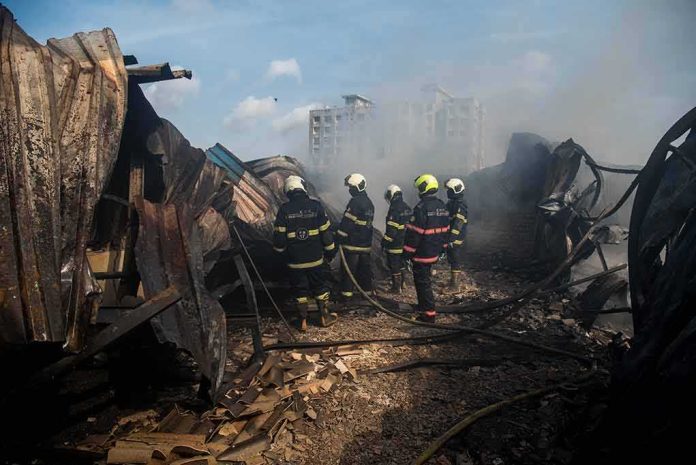
Ukraine’s drone campaign has now reached deep into Russia’s oil system, and the fallout is showing up in refinery fires, shutdowns, and fuel shortages.
Quick Take
- Reuters, BBC, AP, and CNBC all reported repeated Ukrainian strikes on major Russian refineries across several regions.
- Reuters said attacks since early 2026 helped trigger full or partial shutdowns and lower output of gasoline, diesel, and jet fuel.
- BBC Verify found that 21 of Russia’s 38 large refineries had been hit since January, with at least 10 partially or fully suspended.
- The strongest record supports a broad disruption campaign, but not the claim that every one of Russia’s eleven biggest refineries has been independently confirmed as hit.
A Campaign Aimed at Russia’s Fuel Backbone
Ukraine has made Russia’s refining network a clear target, and the public record shows a steady pattern of strikes on major plants. Reuters reported hits on the Moscow refinery, Ilsky, Omsk, and other sites, while other outlets reported damage at Bashneft-Novoil, Slavneft-Yanos, TANECO, TAIF-NK, and Saratov. AP and BBC also described the attacks as part of a wider effort to squeeze Russia’s energy income and fuel supply.
The scale of the campaign matters because these plants sit at the center of Russia’s domestic fuel market. Reuters reported in May that refineries accounting for more than 83 million metric tons a year of capacity had fully or partly halted output, which it said was about one quarter of national refining capacity. Later Reuters reporting said attacks had doubled since the start of 2026 and were cutting gasoline, diesel, and jet fuel output.
That pressure has not stayed on paper. AP reported fuel shortages, long lines at gas stations, and rationing in some regions, while BBC said prices had risen at the pump. AP also reported that President Vladimir Putin acknowledged a “certain deficit” of fuel and promised more protection for oil facilities. Those reports suggest the strikes are not just symbolic. They are affecting the way Russian fuel reaches drivers and industry.
What Can Be Confirmed, and What Cannot
The evidence strongly supports the idea of repeated hits on major refineries, but it does not fully prove the broadest version of the claim. Reuters, BBC, and CNBC name many facilities, yet the provided sources do not give a complete verified list of all eleven biggest Russian refineries with strike confirmation for each one. In other words, the campaign is real, but the exact “all eleven” framing goes beyond what this source set proves.
That gap matters because Russian officials often describe these events differently. Reuters and The Moscow Times reported cases where officials blamed drone debris for fires, or emphasized that air defenses intercepted large numbers of drones. Those statements do not erase the strikes, but they do narrow the dispute to how much damage each attack caused and how long any shutdown lasted. In war reporting, that difference is often the hardest part to verify.
Why the Refinery Story Still Reshapes the War
Even with those limits, the pattern is significant. BBC Verify said 21 of 38 large refineries had been hit since January, and Reuters described a market where refineries had to halt or scale back output. That points to a sustained attempt to force real economic pain, not a one-off raid. Reuters also reported that Ukraine created a long-range command to step up strikes on energy infrastructure, which shows the campaign is organized rather than random.
🚨🇺🇦🇷🇺 UKRAINE STRIKES DEEP INSIDE RUSSIA
Russia’s Orsknefteorgsintez oil refinery in Orsk was reportedly hit by a Ukrainian long-range drone strike, with a fire breaking out at the facility afterward.The refinery sits roughly 1,400 km (870 miles) from Ukraine, underscoring… pic.twitter.com/AwLSTyIyVd
— Mossad Commentary (@MOSSADil) August 11, 2026
The political message is broader than the battlefield. Russia’s officials want to present control and resilience, while Ukrainian officials want to show they can reach deep targets and cut revenue. The public is left with a familiar wartime problem: each side emphasizes the version that helps its own story. What the available reporting does make clear is that Russia’s refining sector is under repeated pressure, and that pressure is now visible to ordinary fuel users.
Sources:
nbcnews.com, reuters.com, apnews.com, themoscowtimes.com, bbc.com, carnegieendowment.org, dw.com