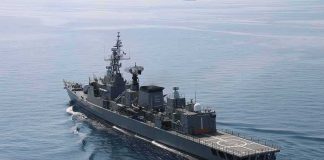
President Trump’s Operation Epic Fury has decimated Iran’s naval threat in the Gulf of Oman, obliterating up to 11 warships in a stunning display of American military dominance that finally answers decades of Iranian aggression in critical shipping lanes.
Story Snapshot
- U.S. and Israeli forces destroyed Iran’s drone carrier Shahid Bagheri, forward base ship IRIS Makran, and multiple corvettes under Operation Epic Fury starting February 28, 2026
- CENTCOM confirmed Iran’s Gulf of Oman fleet reduced from 11 operational warships to zero within days, with Bandar Abbas naval base set ablaze
- President Trump declared mission to “annihilate” Iranian navy and restore freedom of navigation through Strait of Hormuz, which handles 20-30% of global oil traffic
- Iran retaliated by closing the Strait of Hormuz and launching attacks, slashing maritime traffic 85% while threatening global energy markets
Decisive Naval Strikes Cripple Iranian Fleet
U.S. Central Command released thermal imagery on March 3, 2026, confirming the destruction of 11 Iranian warships in the Gulf of Oman, leaving Iran’s surface fleet operationally eliminated. The strikes targeted Iran’s most advanced assets, including the recently commissioned Shahid Bagheri, a 40,000-ton converted container ship with drone-launching capabilities that entered service in February 2025. President Trump announced the destruction of nine to ten ships via social media, stating the rest would “soon be at the bottom” of the Gulf. CENTCOM’s stark assessment declared Iran possessed 11 ships two days prior and “today ZERO,” marking a catastrophic loss for Tehran’s naval ambitions.
The strikes hammered Iran’s critical Bandar Abbas naval base on the Strait of Hormuz, setting the IRIS Makran ablaze and damaging the Konarak wharf infrastructure. B-2 stealth bombers participated in the operation alongside carrier-based aircraft from the USS Abraham Lincoln and USS Gerald R. Ford. Defense Secretary Pete Hegseth and General Dan Caine briefed the mission as a “devastating campaign” focused on eliminating Iran’s naval capacity to threaten commercial shipping. The rapid destruction of Iran’s Jamaran-class corvettes, which previously numbered six vessels, demonstrates the effectiveness of coordinated air and naval power against a modernizing adversary attempting asymmetric warfare strategies.
Trump Administration Restores Maritime Freedom
President Trump framed Operation Epic Fury as essential to ending decades of Iranian naval harassment in international waters, particularly Iran’s seizures of tankers and drone attacks on commercial vessels between 2019 and 2021. The administration’s willingness to decisively engage Iran’s military infrastructure stands in sharp contrast to previous administrations that tolerated Tehran’s provocations. Trump’s direct messaging on Truth Social and X reinforced his commitment to protecting American interests and allies, announcing intentions to secure shipping lanes vital to global commerce. This approach aligns with conservative principles of projecting strength abroad rather than appeasing hostile regimes that threaten freedom of navigation and economic stability for American families.
The operation specifically targeted assets Iran developed to control the Strait of Hormuz through swarm tactics using small boats, mines, and converted commercial vessels. Iran’s asymmetric naval strategy, refined since the 1980s Iran-Iraq War, relied on overwhelming U.S. forces with numerous cheap platforms rather than competing in traditional naval warfare. By eliminating Iran’s command infrastructure at Bandar Abbas and destroying its most capable ships, the Trump administration dismantled this threat model entirely. Military analysts from Naval News characterized the loss of the Shahid Bagheri as a “major setback” to Iran’s power projection capabilities, validating the operation’s strategic objectives of permanently degrading Tehran’s ability to choke global energy supplies.
Strategic Implications and Iranian Response
Iran retaliated by closing the Strait of Hormuz and attacking U.S. positions, resulting in three American service members killed and five wounded, though U.S. carriers remained fully operational despite Iranian propaganda claims. The closure slashed maritime traffic through the strait by 85%, threatening oil prices and global energy markets as approximately 20 percent of world oil flows through this chokepoint. Iran’s IRGC commanders threatened further attacks on commercial shipping, but their capacity to enforce the closure appears severely compromised with their surface fleet eliminated. The strikes occurred within the broader context of Operation Epic Fury’s targets, which included Iran’s nuclear facilities, ballistic missile arsenals, and IRGC infrastructure following the reported death of Supreme Leader Ali Khamenei on February 28.
The long-term impact sets a precedent for preemptive action against adversaries developing capabilities to threaten American interests and allies. The operation echoes 1988’s Operation Praying Mantis, when U.S. forces sank Iranian ships after mine incidents, but on a vastly larger scale reflecting Iran’s expanded threat posture over nearly four decades. Gulf states dependent on maritime commerce and global energy consumers benefit from restored navigation security, while Iran faces potential regime instability with its military backbone shattered and leadership reportedly eliminated. For Americans exhausted by years of Iranian-backed terrorism, proxy wars through Hamas and Hezbollah, and nuclear blackmail, Operation Epic Fury demonstrates the Trump administration’s commitment to ending threats rather than managing them through endless diplomacy and sanctions that enrich Tehran while endangering our servicemembers and allies.
Sources:
Naval News – U.S. Strikes Destroy Iran’s Main Naval Assets
Military Times – 9 Iranian Naval Ships Have Been Destroyed and Sunk, Trump Says
The War Zone – Iran’s Key Naval Base on Strait of Hormuz Set Ablaze From Strikes
USNI News – Iranian Naval Forces Are Major Target in Operation Epic Fury Strikes
Wikipedia – 2026 Iran–United States Crisis